Monday, March 13, 2017

Macedonian Names

It is no secret that the most notable figures of the ancient kingdom of Macedonia had Greek names. This does not surprise, for the Macedonians were indeed Greeks and the Greek language was the lingua franca of the region at the time. (We are aware that the Macedonians had their own dialect, and this will be the topic of a future post.)

In this short post today, we take a look at the names of the two best known Macedonians and dissect them to prove their Greekness. So let's get straight into it.

Alexander the Great: Ἀλέξανδρος (Aléxandros) = ἀλέξω (verb aléxo meaning to ward off, to defend) + ἀνήρ (anír, genitive being ανδρός andrós, meaning [of] man) = Protector, defender of man

King Philip II: Φίλιππος (Fílippos) = φίλος (fílos meaning dear, loving, friend) + ἵππος ([h]íppos meaning horse) = Fond of horses, horse's friend

When the Yugoslavs hear this, they usually have nothing to say. Some try to argue that just because the ancient Macedonians had Greek names that doesn't make them Greeks. While other, more extreme Yugoslav nationalists will say that Aleksandr and Filip are names belonging to the same language family as Gojko and Zoran.

In any case, their arguments are always very weak, baseless in fact. They cannot claim that the ancient Macedonians were not Hellenes despite having Greek names and promoting Hellenic culture because they were forced to. (By who?) It just makes no sense.

Taking a look at other historical figures of the time and the names they bore, we can see that names often, if not always, reflected the language spoken and, consequently, the identity of the person.

Take Julius Caesar for example. Emperor of Rome, his birth name in Latin was Gaius Julius Caesar. In the history books we don't read that Caesar was secretly a Gaul or a German barbarian.

What about Tutankhamun, the boy pharaoh of Egypt? He wasn't secretly a Hebrew named Solomon or an Arab born Walid.

As always, if you'd like to get in touch with us, give some feedback, or ask a question, please email melbourne.macedonian@gmail.com.

Friday, January 27, 2017

EU Parliament President's Macedonia Gaffe

Controversial remarks made by recently installed president of the European Parliament Antonio Tajani have hit the media spotlight. According to Greek newspaper Kathimerini, during an interview while visiting Skopje last year, Mr. Tajani stated:

"Macedonia [sic] is a beautiful country. Everyone in Italy knows Macedonia [sic]. Why? Because Alexander the Great and Philip the Macedonian are your very well-known ancestors. There's no Europe without Alexander, as he was the first king who stopped an invasion from Iran and those countries. That's why we call him great, because he strengthened Europe's borders."

The revelation of the comments was naturally followed by vigorous protests from the Greek foreign ministry and the country's main political parties, as well as from one of the most prominent Greek MPs in Brussels, Dimitris Papadimoulis (Syriza party), who is one of the European Parliament's vice-presidents.

The strong denunciation of the comments from Greece – which is a member of the EU unlike FYROM – led to president Tajani posting in Greek on Twitter yesterday that "I know history very well. Alexander the Great was Greek and had ideas that contributed to the birth of Europe".

Preceding Mr. Tajani's tweet was a statement issued by the European Parliament confirming its firm stance on FYROM and that the only name by which it recognizes the country is the Former Yugoslav Republic of Macedonia

For the record, Antonio Tajani is a member of Silvio Berlusconi's right-wing Forza Italia party as well as the European People's Party.  He was installed president of the European Parliament just over a week ago on January 17.

Monday, January 23, 2017

Ecclesiastical Issues Facing FYROM and its Diaspora (II)


Today we continue from where we left off on our previous post regarding the so-called "Macedonian" church.

We talked about how the church in FYROM is schismatic – i.e. not in communion with any of the canonical churches that make up the Orthodox Communion, whether they be Serbia, Bulgaria, or Russia – and (briefly) explained how this situation came to be.

We also stressed that the same status applies to any (arch)diocese or metropolis in the diaspora identifying as "Macedonian" Orthodox, as these communities are under the jurisdiction of the schismatic church in FYROM.  

A question was sent to us asking whether the Yugoslavs being schismatic meant they had different beliefs. The answer, simply put, is no. For all heretical churches are indeed schismatic, but not all schismatic churches are heretical. 

That said, schismatics still cannot receive holy communion in a canonical Orthodox church. And this makes perfect sense, because there can be no common cup if there is no unity. Just like a Roman Catholic or member of one of the Protestant churches cannot receive communion in a canonical Orthodox church, neither can someone belonging to a schismatic Orthodox church. 

One of us here at Melbourne Macedonian remembers a priest once explaining to him that anyone outside of the Church who goes to a canonical priest to receive holy communion does not receive Body and Blood, but fire. 

Other schismatic churches that have left the Orthodox Communion but still identify as Orthodox include the Kyivan patriarchate of Ukraine (led by patriarch Filaret) and the so-called church of Genuine Orthodox Christians (old-calendarists) based in Greece.

Archbishop Jovan Vraniskovski leads a small church (number-wise) in FYROM that falls under the jurisdiction of the Serbian patriarchate and is canonical. This church was established in 2003 after archbishop Jovan, a hierarch of the schismatic church at the time and based in Veles (Greek Bελεσσά), responded positively to calls from Serbian patriarch Pavle the previous year for the church in FYROM to return its mother (Serbia).

Archbishop Jovan
Note that Jovan, like the schismatic Stefan, also bears the title of archbishop of Ohrid (Greek Αχρίδα). Some may wonder why the city of Ohrid bears more religious importance than Skopje (the capital) for the church in FYROM. This is because Ohrid was once one of the region's main spiritual hubs, where the faith flourished and a number of saints were born. St. Clement (Greek Κλήμης) is one of them. (He was a disciple of Sts. Cyril and Methodius, who brought literacy to the Slavs with the creation of the Cyrillic alphabet.) 

The future of the church in FYROM is unclear. From what it looks like, the status quo will not change any time soon and the group led by archbishop Stefan will remain outside of the Orthodox Communion going forward. There's simply too much politics and too many big egos involved that make reunification with the Serbian patriarchate and the other Orthodox churches very hard. 

Indeed, it's very unlikely that the "Macedonian" church would accept returning to its previous status of daughter church to the Serbian church, thus becoming subordinate once again. And it's even less likely, impossible in fact, for independence to be granted to the "Macedonian" church by the Ecumenical Patriarchate of Constantinople, for doing so would mean bringing a 15th autocephalous church into the Communion with a name that is not in line with history or nature and distorts the facts.

Sunday, January 8, 2017

The Macedonian [sic] Australian Pride Facebook Page


Our friends at Macedonian [sic] Australian Pride have sent their love via Facebook to the Russian Ministry of Foreign Affairs this Julian-calendar Christmas Eve (6th January). Why? Because apparently a Russian graphic labelling the northern Greek administrative regions of Western, Central, and Eastern Macedonia (and Thrace) with their actual names constitutes Russian recognition of these regions as territories of FYROM.

It's posts like these and the comments that follow that make us laugh and realize that the Yugoslavs really don't have any arguments or facts to back their claims. 

For example, apparently only the ancient kingdom of Macedonia had a monarch. Other Greek-speaking regions had prime ministers and presidents, as they were democracies. Guess that means King Leonidas of Sparta (the 300) was not a king after all. 

Another example is the name Thessaloniki, which was apparently invented only last century. Guess that means St. Paul's two letters to the Thessalonians found in the New Testament need to be renamed. And while we're at it, we may as well rewrite the history books so that the world knows King Philip II never had a daughter called Thessaloniki...

As noted in a previous post, Melbourne Macedonian has no intention of engaging in round-the-clock online warfare with the various Yugoslav-run pages on social media sites.

However, if we see something we deem to be incorrect or deceiving, out of line with history or lacking sheer common sense, we will respond. 

Wednesday, December 28, 2016

Ecclesiastical Issues Facing FYROM and its Diaspora

Ecclesiastical, that is, church-related, issues are one of our favorites here at Melbourne Macedonian, and in this post we talk about the "Macedonian" church and explain where it stands in the Orthodox world today.

One of the largest Orthodox churches
in the world: St. Sava in Belgrade
To begin, we have to understand what the Orthodox Communion is and see which churches constitute it. Currently, there are fourteen (14) autocephalous, or self-governing, churches within the  Communion. They are, in order of primacy according to Constantinople: the patriarchates of Constantinople (Ecumenical), Alexandria, Antioch, Jerusalem, Moscow, Serbia, Romania, Bulgaria, and Georgia; and the churches of Cyprus, Greece, Poland, Albania, and the Czech Lands.

As one can see, only four churches have jurisdiction within the Balkans: Albania, Bulgaria, Romania, and Serbia. The "Macedonian" church of FYROM declared itself autocephalous and broke away from the Serbian Patriarchate in 1967. This was an attempt by shady nationalist figures with considerable power at the time to create a separate "Macedonian" church with its own (not Serbian, and by all means not Bulgarian) identity and, above all, authority, and whose existence would strengthen the case for a separate "Macedonian" nation different ethnically and historically to the other peoples of the region, especially the Orthodox Serbs and Bulgarians.

The reason for the "Macedonian" church's declaration of independence being rejected by the Serbian church is that such things cannot be determined by daughter churches, but by mother churches. That is, a church subordinate to another church can only become independent, autocephalous, or self-governing, if the other church grants it this status. In this case, the "Macedonian" church (daughter) could not declare independence from the Serbian church (mother), but the Serbian church could have granted it independence if its synod ever deemed this appropriate. Simply put, this is how things work within the Orthodox Church. For example, today the church of Belarus is subordinate –that is, belongs– to the church of Russia, which became autocephalous in 1448 and was elevated to patriarchate (Moscow) in 1589 by Constantinople, to which it answered up until the granting of independence. 
Archbishop Stefan
(schismatic)

Fifty years on, and the so-called "Macedonian" church currently headed by archbishop Stefan Veljanovski of Ohrid still remains unrecognized by every church within the Orthodox Communion. What this means is that all sacraments conducted by priests belonging to this schismatic church are considered invalid. It should be noted that congregations in the diaspora (e.g. Australia, Canada) identifying as "Macedonian Orthodox" belong to this church.

That said, there is a church within FYROM, a very small one, that is canonical and in full communion with the other churches. This is the church under the jurisdiction of the Serbian patriarchate and led by archbishop Jovan Vraniskovski, also of Ohrid...

But that's all for now: This topic will be continued in a future post. 

Sunday, December 11, 2016

The Macedonian [sic] Australian Community Organization of "Vardar" (II)

Many are asking us why we bother with the Yugoslavs and try to rebut their claims. There's no point dealing with these people –they say– they're unstoppable in their determination to change the facts.

Melbourne Macedonian was created with the intention of getting the Greek perspective on the Macedonia Issue out there. That's what we've started to do (we'd like to think) and that's what we'll continue to do.

For we believe it's important to stand up for what's right.

That said, Melbourne Macedonian has no intention of engaging in round-the-clock online warfare with the various Yugoslav-run pages on social media sites like Facebook, where many untruths are being written on a regular basis.

However, if we see something we deem to be incorrect or deceiving, out of line with history or lacking sheer common sense, we will respond. And even if it's just for the record.

So following our previous post addressing misleading statements found on the Facebook page of the so-called Macedonian Australian Community Organization of "Vardar", we would like to make the following points.

It's funny that the Vardar Community Organization should refer us to their video dated 12 April 2016 where Liberal prime minister Malcolm Turnbull acknowledges their country as "Macedonia". Why? Because, firstly, after eight (8) months and in spite of the prime minister's promise to 'take on board their concerns', there has been no change whatsoever in Australia's position on the name (Australia continues to recognize their country officially only as FYROM) and, secondly, their vocal advocate Luke Simpkins no longer represents the electorate of Cowan and is no longer a member of parliament (he was unseated by Labor's Anne Aly in the July federal election).

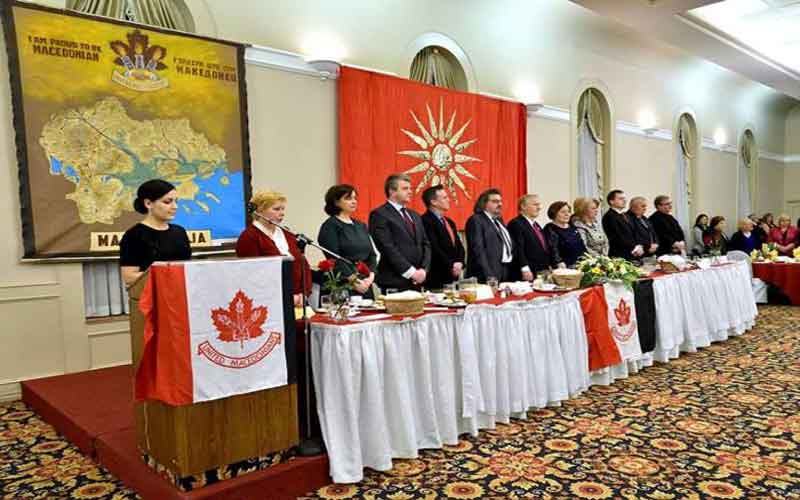
Also, we would like to stress that there is nothing wrong with Yugoslav organizations being active in Australia and running cultural events. What is wrong, in our opinion, is these organizations provoking the local Greek community unashamedly by, amongst other things:
  • Distorting historical facts, e.g. claiming the ancient kingdom of Macedonia was in fact Slavic and not Hellenic (= Greek)
  • Stealing Hellenic symbols, e.g. using flags with the Vergina Sun at community halls and cultural events
  • Making irredentist claims (informally) on Greek territory, e.g. putting up maps of "Greater" Macedonia at community halls, teaching their young people that Thessaloniki and Florina rightly belong to FYROM
  • Arguing cases that are simply baseless and outlandish, e.g. claiming that the Slavic-speaking peoples of northern Greece were victims of "genocide" during the 20th century.

Indeed, as we said in our previous post, the Vardar Community Organization would be doing itself a favour if before pressing Enter it read over everything it writes a second or third time. 
A Yugoslav community function
in Toronto, Canada

They seem to be forgetting that the Greek community in Australia, Canada, and the U.S. is much larger and better established than theirs, hence misleading statements and provocative actions will always trigger a strong reaction.

Let's not forget ourselves that FYROM's population sits at around 2.1 million, or one fifth that of Greece's, and about 25% of this 2.1 million is ethnic Albanians. Just for the record. 

Tuesday, December 6, 2016

The Macedonian [sic] Australian Community Organisation of "Vardar"

Melbourne Macedonian has been doing a bit of surfing online lately, particularly Facebook, to see what's out there and what both sides are saying about the Macedonia Issue.

One particular Facebook page, run by the Yugoslavs, caught our attention: The Macedonian [sic] Australian Community Organisation of "Vardar".

Scrolling through posts from the last three months or so, we picked up a number of items (some very provocative) and chose two posts we believe are worth commenting on. (Note that all italic wording within the quotation marks below is that of the Vardar Community Organization.)

'Ask this Orthodox Priest that doesn't belong to the Macedonian Orthodox Church as to why other churches are yet to recognise the existence of our holy Macedonian Orthodox Church!'

The church in today's FYROM broke away from the Serbian Patriarchate in 1967 in an attempt by shady figures from the nationalist political scene of the time to create a separate "Macedonian" church that would strengthen their case for a "Macedonian" nation different ethnically and historically to the rest (Serbs, Bulgarians, Bosnians, etc). As a result, none of the 14 autocephalous churches that make up the Orthodox Communion today recognize the schismatic "Macedonian" church and all sacraments are considered invalid. In order for this to change, the "Macedonian" church needs to stop being used as a channel for FYROM government propaganda and the name issue needs to be resolved. Otherwise, it would be impossible for hierarchs of the Greek-speaking churches (Constantinople, Alexandria, Jerusalem, Cyprus, Greece, and Albania) to acknowledge the existence of a "Macedonian" church with a "Macedonian" flock. Furthermore, to recognize the Yugoslavs and their church as both canonical and Macedonian would be an insult not only to the Greek-speaking clergy, but to all clergy and their priesthood, for doing so would be an act of complete disregard for history, which is written by the Divine Creator alone and cannot be rewritten by man.

'Yesterday "Ensemble Macedonia" visited the Macedonian Orthodox Monastery "Saint John the Baptist" or Bigorski Manastir where they sung old Macedonian folk songs. This song is called "We are too the children of Macedonia" and represents the struggles of the Macedonian people particularly the Macedonians from Aegean Macedonia (today's Northern Greece) who were forced to flee their homes after Greek genocide was forced upon them after geographical Macedonia was divided in 1913 between our neighbours'

The Vardar Community Organization would be doing itself a favour if it read over everything it writes a second or third time before pressing Enter. To suggest that the Slavic-speaking populations of northern Greece (yes, they did exist and were primarily Bulgarians and Yugoslavs) were victims of genocide is a big call to make, and an insult to all Greeks. Indeed, genocide is a very controversial topic and should not even be insinuated if the evidence is clearly not there. Armenians, Greeks, and Assyrians, for example, have encountered a number of obstacles, both internal and external, in the push for international recognition of the atrocities their ancestors endured at the hands of the (Ottoman) Turks during the early 20th century. And these groups have history and the facts on their side. Now, for a group of Yugoslavs to cite genocide out of the blue when trying to explain the impact World War I had on the Balkan region, not to mention the internal struggles in the region and the self-serving political interests of a select few, is very foolish, to say the least, but also dangerous politically.

As always, if you'd like to get in touch with us please email melbourne.macedonian@gmail.com

Friday, December 2, 2016

Who Gave You the Right to Negotiate My Name?

The original in Greek
The terms "international, bilateral, constitutional" don't fool us.

The geographical terms "North, Upper, Vardar Macedonia" (with or without brackets) don't fool us.

"North" Macedonia suggests there's a "South" Macedonia. "Upper" Macedonia suggests there's a "Lower".

The countries that have recognized Skopje [FYROM] with its constitutional name have stated that once the issue is resolved, they will refer to FYROM with its new name. So why do you give away without thinking twice the name of 2.5 million [Greek] Macedonians?

Say No to a composite name. Overthrow the status quo.
The problem is not ours, but FYROM's.
We don't need a "bilateral" solution – they do.

[Greek diplomat and political activist] ION DRAGOUMIS ONCE SAID:
'KNOW THAT IF WE HURRY TO SAVE MACEDONIA, MACEDONIA WILL SAVE US! SHE WILL SAVE US FROM MEDIOCRITY AND DECAY, SHE WILL SAVE US FROM THE SHAMEFUL SLEEP, SHE WILL FREE US. IF WE HURRY AND SAVE MACEDONIA, WE WILL BE SAVED!'

No matter how many countries recognize them [FYROM], Greece will have the final word.

We make this plea to you. Don't sell out our name.
You know very well that there was no "Macedonia" before 1945.
You know very well the plans of Marshall Josip Broz (Tito).
So why should we all of a sudden recognize a non-existent, pseudo-state?

As the first president of FYROM, Kiro Gligorov, once said:
'We are Slavs and came to the region during the 6th century AD... We are not descendants of the ancient Macedonians. Serious historians are laughing at what's happening in my country. The way we're going, we'll end up descendants of Adam and Eve and will prove that even paradise is Macedonian.'

MACEDONIA IS GREECE AND NOT NEGOTIABLE.

Thursday, November 24, 2016

FYROM Propaganda

The SMS received on the journey
to, dated 27 June 2014
For quite some time now the governments of FYROM have been making use of various forms of propaganda in order to justify their use of the name Macedonia and substantiate their attempts to fabricate a new "Macedonian" history that serves their political interests.

During the European summer of 2014, a friend of ours was travelling by bus to a destination in Central Europe from Thessaloniki. The journey involved crossing the borders of several Balkan countries, including FYROM.

Passing through the Greek village of Evzoni (Εύζωνοι), Kilkis prefecture, and arriving at the Greece-FYROM border, the following SMS from T-Mobile reached our friend's phone: 

"Welcome to Macedonia, the cradle of civilization [1]. During your stay we strongly recommend you visit the Museum of the Macedonian Struggle [2] and the Memorial House of Mother Teresa in Skopje [3], the Memorial Center of Toshe Proeski in Krushevo, the Museum on Water in Ohrid and the Ancient Observatory in Kokino."

We would like to make the following observations.

The same messages were received
on the journey from, here dated
7 July 2014
[1] What provokes firstly is not so much that the Yugoslavs refer to their country as Macedonia, but that they now consider it the cradle of civilization. This is a big call to make. According to the Oxford dictionary, cradle in this context means "A place or process in which something originates or flourishes." What could the Yugoslavs be referring to here? What could possibly have originated or flourished in their country, which was officially established only in 1991, following the breakup of Yugoslavia? Could it be democracy, theatre, or science? Philosophy, perhaps? No, these originated and flourished in ancient Greece, which many today consider to be the cradle of Western civilization. Unable to find an answer, we did a search on Google for cradles of civilization, but struggled to find anything listing "Macedonia". The only cities or countries we found other than Greece were Rome, Mesopotamia (Sumer), Egypt, and China.

[2] The Macedonian Struggle (in Greek Ο Μακεδονικός Αγώνας) was a series of escalated tensions between 1904-08 (others consider these to have begun earlier) in which two sides, Greek and Bulgarian, fought for control over the region of Macedonia. There is no doubt that Yugoslavs participated in the various battles, for many did indeed live in villages today belonging to modern-day Greece and Bulgaria, but to suggest that the Struggle was for FYROM and that their nation (which, at the time, did not even exist) and their people played a key part in the Struggle is simply unhistorical and absurd.

[3] It is true that Mother Teresa, who was canonized a saint just this year by the Roman Catholic Church, was born in Skopje. She was not, however, born to Yugoslav parents. She was Albanian, an important ethnic group today in FYROM, considering that it constitutes, believe it or not, 25% of the country's overall population (which is currently estimated at a mere 2.1 million).

These deceiving messages were received in mid-2014. Two years have passed since then, and it would be no surprise if they're still being sent out today to every person with a phone entering or, as they'd like to see it, visiting their country, the "cradle of civilization". FYROM propaganda at its finest.

Monday, November 21, 2016

The Macedonian [sic] Cultural Festival in Williamstown

The flyer for the event
The "Macedonian" Cultural Festival is back for its second year and due to be held this upcoming Sunday, 27 November, in Melbourne's seaside suburb of Williamstown. As a lot has already been said (and written) regarding this controversial festival, we only wish to make the following observations.

The use of the Vergina Sun by the Yugoslavs as their de facto national symbol is unacceptable and completely baseless from a historical perspective. This was the symbol of the ancient Macedonian kingdom, which was Hellenic, and should belong only to Greece for use. The Yugoslavs have their own flag –which is actually an altered Vergina Sun– and that is what they should be using, not the flag and symbols of another nation.

The sight of Yugoslavs dressed as what appears to be their understanding of how ancient Macedonian soldiers went to battle is, to say the least, embarrassing. In no other country of the former Yugoslavia would you see such a thing, that is Slavs trying to revive the past of someone else's ancient ancestors. Not in Serbia, not in Croatia. Not in Bosnia, not in Slovenia. Not even in the diaspora do these communities waste their time with such ridiculous displays during cultural events. When will the Yugoslavs finally realize that they've got it all wrong, and that they are in fact not the descendants of the ancient Macedonians? 

From last year's festival

Thursday, November 17, 2016

What is the Macedonia Issue?

The Macedonia issue is more than just a fight over a name. It's about identity and everything that constitutes this: culture, language, history.

It's a complicated matter and has in the past involved more than two parties.

Greeks and their northern neighbours have been involved in it from the very beginning, but so too have Bulgarians and, to a lesser, now almost non-existent extent, Albanians and Serbs.

For the record, this blogspot will focus primarily on the dispute between Greece and FYROM, Greeks and Yugoslavs.

Let's now (briefly) take a look at where both sides stand.

As far as Greece is concerned, Macedonia is a region today divided between itself (roughly 52%), FYROM (45%), and Bulgaria (3%).

It is where an ancient Greek kingdom was established and Hellenic (= Greek) civilization flourished under the leadership of historical figures such as Alexander the Great and his father, King Philip II.

The Greeks hold that the Macedonians were indeed Hellenes because:
  • They had the same names as the rest of the Greeks (more on this in a future post)
  • They spoke the same language as the rest of the Greeks
  • They had the same religion (twelve gods of Olympus) as the rest of the Greeks
  • They had the same architecture as the rest of the Greeks
  • They had the same customs and traditions as the rest of the Greeks (including participating in the Olympic Games).

As a result, Greece sees the use of the name Macedonia for its neighbour to the north as an attempt to change history and distort the facts, whereby a modern Slavic nation is trying to present itself to the world as the continuation of an ancient Greek kingdom with which, in reality, it has no association whatsoever.

"Greater" Macedonia
Furthermore, Greece believes that allowing the Yugoslavs to use the name Macedonia for their country will lead to eventual irredentist claims on the remaining two parts of the region, particularly Greek Macedonia (that 52%) and its capital, Thessaloniki.

Indeed, such claims are already being made, maybe not on an official level, but certainly informally among Yugoslavs, especially those residing in the diaspora.

Despite these claims though, the Yugoslavs, it would appear, are not united on their position regarding what they represent exactly.

Many consider themselves the direct descendants of the ancient Macedonians who, in their eyes, were always Slavs, while others argue that the ancient Macedonians were not Greeks but IllyriansThracians, or some combination of the two, and it is with these people that their Slavic ancestors interbred upon entering the Balkans around the 6th century AD, and into their society that they assimilated, creating over time the modern-day "Macedonian" nation.

In any case, FYROM has been employing various methods over the years –most notably during now former prime minister Nikola Gruevski's time in office (2006-16)– to legitimize its use of the name and justify its case for international recognition.

Simply put, the Yugoslavs consider the Greek argument nonsense and view historical figures like Alexander the Great, amongst others, as their own.

Wednesday, November 16, 2016

A New Beginning

Welcome to our blogspot.

Melbourne Macedonian is a team of young Greek men and women passionate about the Macedonia issue.

This is an issue close to our hearts and about more than just a name. It's about history and culture, it's about identity.

And it's becoming more topical than ever as new provocations arise and the world becomes more globalized.

Based in Australia's second largest city, we seek to give a Greek perspective on all matters relating to the issue, whether they be old or new, originating from the region of Macedonia or somewhere else.

Our position is simple: The people of the Former Yugoslav Republic of Macedonia (FYROM) have no claim, cultural or historical, on the ancient Greek kingdom of Macedonia, its former inhabitants, its language, its name.

This applies as well to all irredentist claims today coming from members of the FYROM community, primarily in the diaspora, on the modern, northern Greek region of Macedonia and its capital city, Thessaloniki.

Our ultimate goal, therefore, is to educate people on the issue, especially young people of Greek descent, those second- and third-generation Greeks living in countries like Australia, Canada, and the U.S., so that they too may one day be able to stand up and defend the history of their homeland properly –with facts–, should the need arise.

Posts will be in English and made, where possible, at least once a week.

Melbourne Macedonian is independent and not affiliated with any existing Greek-Macedonian organizations or bodies, whether they be based in Greece or the diaspora.

If you'd like to get in touch with us, give some feedback (positive or negative), or even ask a question, please email melbourne.macedonian@gmail.com.

A new post will follow soon.

Yarra River, Melbourne